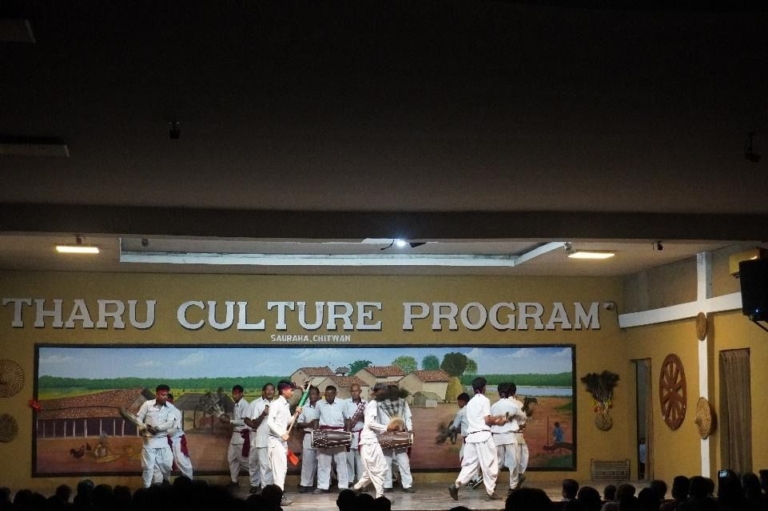
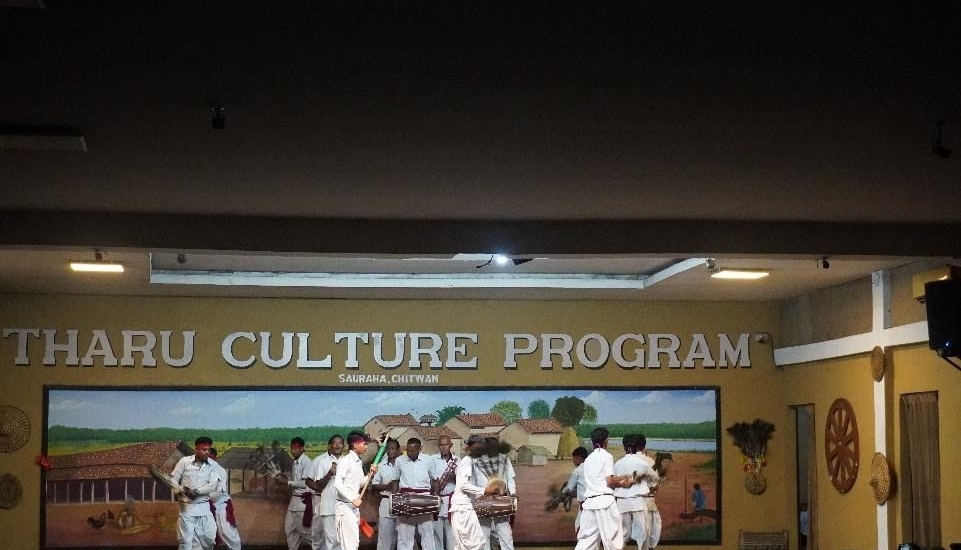
Director of Himalayan Center for Art, Culture and Science recently visited Nepal to explore the art and culture of Nepal. She interacted with Tharu community of Nepal and discussed with them about their culture and their livelihood sources. She was lucky to record their traditional dance in Sauraha, She noted that Tharu community is progressing but at the same time they are maintaining and nurturing their culture and traditions. According to the National Population and Housing Census 2021, Nepal is home to 142 distinct ethnic and caste groups, of which 59 are formally recognized as distinct indigenous ethnic groups titled Adivasi Janajati, their total population amounting to 29,164,578 (35.08% of the total population), although indigenous organizations believes that the actual figure is closer to 50%. These indigenous groups are extensively diverse and are distributed across the Nepalese topography, ranging from demographically prominent groups such as the Magar, Tharu and Tamang (constituting 7.1%, 6.2% and 5.6% of the total population, respectively) to groups such as the Rajbanshi, Chepang, Sunuwar and Thakali; Nurang is officially regarded as Nepal’s smallest indigenous group, with a population of only 36 individuals according to the 2021 census. Beyond Nepal, the Tharu community also resides in the Indian states of Uttarakhand, Uttar Pradesh, and Bihar, where they maintain close cultural and historical ties with their counterparts across the border. Examining the status of the Tharu people in both Nepal and Uttarakhand provides valuable insights into the shared challenges and opportunities related to indigenous rights, cultural preservation, and socioeconomic
‘A study on Socio-Economic Status of Indigenous Peoples’ in Nepal by Subba et al (2014), on the basis of data aggregated in the Nepal Living Standards Survey (NLSS), estimates that although the proportion of individuals from indigenous communities living below the poverty line is similar to national averages (1/4th of the total population), significant disparities exist between these indigenous communities; while Newars, Gurungs and Sherpas represent lower poverty rates, over 40% of the population of Kumal, Sunuwar, Majhi and Chepang communities lies below the poverty line. Labour Force Participation among indigenous communities is significantly high (80%), primarily due to the earlier entry of children into the workforce, with three-fourths of all households being agricultural households and one-fourth of such households being led by women. 46% of all employed individuals work 40 hours or more per week, with 41% of indigenous children having to work while also attending school.
Shakya (2025) states that despite constituting a significant proportion of Nepal’s population, indigenous communities have been historically marginalized during and after the consolidation of the Nepalese nation-state through land and resource dispossession, resource deprivation, political and military violence, systemic exploitation by dominant-caste enforcers (Khas-Arya) through the legalization of unequal stratification by the establishment of the 1854 Muluki Ain (civil code), political exclusion and the erasure of indigenous dialects and cultures under cultural hegemony.
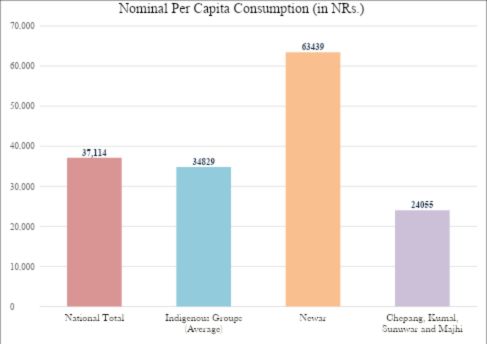
Over 63% of indigenous people reside in mud-bound houses and although Newar, Gurung and Sherpa communities have increased access to electricity, sanitary systems and toilets, large proportions of indigenous communities have limited, if not poor access. Over 35% of hill-indigenous members have not attended primary education and the Gross Enrollment Ratio of Terai indigenous people in higher secondary school is merely 58% (although Newar, Sherpa, Bhote and Thakali communities represent increased enrollment ratios across primary, secondary and higher secondary levels). As the level of the educational attainment of a household’s head corresponds to its poverty status, over 34% of hill-indigenous households (other than Newari households) with illiterate heads are below the poverty line. The proportion of indigenous households (other than the Newars) with a primary schooling facility within 30 minutes is lower than the national average and only 24% of hill-indigenous communities have access to a Primary Health Centre (PHC) within 30 minutes of their home. In comparison to 65% of hill-Brahmin women who deliver their infants at registered health facilities, only 25% of indigenous women do so, with the exception of Newar and Gurung communities; 75% of indigenous women deliver at home with the assistance of family members and neighbours.
The Tharus
The Adivasi Janjati of Nepal comprise diverse indigenous communities with distinct languages, cultures, and traditional livelihoods. Despite constitutional recognition and legal safeguards, many continue to face socioeconomic disparities, limited access to education, healthcare, and employment, and challenges in preserving their cultural identity. Among these communities, the Tharu people are one of the largest indigenous groups, primarily inhabiting Nepal’s Terai region. The Tharu possess a rich cultural heritage, unique customs, and a long history of adapting to the forested plains of the Himalayan foothills. Beyond Nepal, the Tharu community also resides in the Indian states of Uttarakhand, Uttar Pradesh, and Bihar, where they maintain close cultural and historical ties with their counterparts across the border. Examining the status of the Tharu people in both Nepal and Uttarakhand provides valuable insights into the shared challenges and opportunities related to indigenous rights, cultural preservation, and socioeconomic. The Tharu people are an indigenous ethnic group, native to the Terai plains of Southern Nepal and Northern India, distributed across Mechi to Mahakali in Nepal and the states of Uttrakhand, Uttar Pradesh and Bihar in India. As an ‘umbrella-ethnonym’, the term “Tharu” historically unites culturally and linguistically diverse endogamous groups; the Tharu community accounts for approximately 6.2% of the total population in Nepal (1,807,124), representing one of the largest indigenous communities in the country, with the largest concentration of members observed in the Sudurpashchim (17.3%) and Lumbini (15.3%) provinces.
The genesis of the Tharu population has been attributed to multiple origins by indigenous recollections and scholarly writing, including Rajput communities, the Thar region of Sindh and ancestral ties to West Asian ethnicities. The Tharu have also been associated with the Shakyas and the divergence of Buddhism into the Mahasanghika and Sthavira sects; some researchers propound that the colloquial pronunciation of Sthavira as Thavira later converged to the term Tharu. However, it is widely acknowledged within Nepal, particularly by prominent historians such as Baburam Acharya, Harka Gurung, Tej Narayan Chaudhary and Bhulai Chaudhary, that the Tharu people were the primary indigenous inhabitants of the Terai, with Gurung characterizing the Tharu as an “aboriginal” ethnic group; the Tharus regard themselves as a distinct ethnic group despite extensive variation, referring to southerners as Baji.
Economy, Social Organization and Political Mobilization
The agrarian economy of the Tharu people has been historically rooted in subsistence short fallow shifting cultivation, animal husbandry and forest foraging, owing to the alluvial-rich Terai topography and an evolutionary resistance to malaria. Household and community organization often corresponds to “familial, communal and ritual roles connected to agriculture”. The Rana Tharu of western Terai reside as extended joint families in longhouses (Badaghar); households consisting of members across multiple generations are led by the patriarch (Mukhiya), who assumes economic, legal and social authority. Social relationships and transactions are mediated by customary laws, enforceable by clan (kul) elders and the village chief, denoted as Aguwa, Mahtwa, Barghar, Kakandaar and Pradhanwa across regions and communities. While Yadav and Sharma note that the village head inherits his authority hereditarily, the positions of the Bhalmansha (the head’s deputy) and Chaukidar (responsible for conveying the head’s decisions and calls to gather) are acquired.
Across the years, Tharu political organization has been repeatedly transmuted by regional and national political mobilizations. The establishment of the Tharu Welfare Society (TWS) in the central and western Terai in 1951 emerged in response to the socio-economic marginalization of Tharu communities, particularly due to land alienation and the lack of institutional recognition of the indigenous governance systems of the Tharu by centralized state structures; the TWS came to function as a governmentally recognized regulatory body (with the authority to impose fines and minor punishments for customary offenses) well into the 1970s. The Tharu Indigenous NGO Federation (TINGOF) represented the rise of NGO-led mobilization of Tharu communities in mid and far-western Terai since the 1980s, which developed due to the rise of bonded labor contracts (Kamaiya) imposed by Pahadi landlords over Tharu settlements following anti-malarial campaigns. TINGOF’s large-scale protests against the legality of bonded labor resulted in its abolishment in 2000. The Nepalese Civil War (1996-2006) between the then rulers of the Kingdom of Nepal and the Communist Party of Nepal (Maoist) exposed Tharu communities to new forms of political mobilization (millitancy) and military state violence; over 85% of recorded disappearances in the districts of Bardiya and Banke were noted from Tharu communities. Post-conflict Tharu organizations such as the Tharuhat Autonomous State Council (TASC) and The Tharuhat Joint Struggle Committee (TJSC) emphasized the incorporation of “pre-existing” Tharu collectives, either for the realization of a Tharuhat state or to protest against Mahadeshi demands for uniformization. The revitalization of the Tharu system of annually elected governance (Badghar) and the call for its sanctioned recognition by the Nepal government (in opposition to its exclusion under the Local Self Governance Act of 1999) significantly influenced political mobilization; the Badghar Mahasangh, established in 2010, advocated for the recognition of Tharu customary law, budget allocations and reservations for Tharus in government employment.
Art and Culture
The artisan, semiotic and visual culture of the Tharu is significantly influenced by their adherence to naturism (particularly agrarian cycles) and the interplay between Theravada Buddhist, Hindu and pantheistic animist traditions; adherence varies greatly by region and demographic. Tharu communities celebrate Maghe Sankranti on the first day of the Nepali month of Magh (the eleventh month of the Hindu lunar calendar), venerating the end of the Winter Solstice, the apparent northward journey of the sun (Uttarayana) and longer and warmer days. Other major festivals and religious events commemorating natural, geographical and agrarian cycles include Asare Puja (a rain-invocation ritual), Aghan (a post-harvest festival) and Jur Sital (a celebration of the first day of the year in the month of Vaisakha in the Terai). Ritualistic fasting is central to the festivities of Jitiya, wherein a strict waterless fast is maintained by women for the well-being of their families and children and Atwari, celebrated among the western Tharu of Terai, where men fast for their sisters and venerate Bhimasena, the second Pandava. The Gothale festival is celebrated annually during the Kojagrat Purnima following the immersion of the Dashain Tika, commemorating Shri Krishna lifting the Govardhana Mountain.
Cultural art forms include Ashtimki wall paintings among the Tharu inhabiting the western regions of Nepal that integrate geometric representations of mythological figures and creation myths during the Ashtimki festival (on the day of Krishna Janmashtami), floral sculpted bas-relief clay designs depicting birds and animals referred to as Mokha art (known as Payar in Saptari, Siraha and Udayapur) among the Tharu in the east, grass weaving and basketry using Sikki and Moonj grass and textile art categorized as Tharu Applique. Ashtimki art, in particular, is associated with the vernacular epic Sakhiya, the verses of which are memorized and performed by all unmarried women (bathaniya) during Krishnashtami and Dasya; rectilinear depictions of “Kanha” (Krishna) are often accompanied with graphical forms representing gopinis, the Kalamba tree, farmers, surujbharara (the sun) and jonhya (the moon). Other representations including those of the Pancho Pando (Five Pandavas) and Durpati (Draupadi), who are also revered in the Tharu folk epic of Barkimar and the creation myth of Gurbabak Jarmauti, which narrates the creation of the realms (ecological spheres) of the earth and their beings by Gurbabak, “the first saintly Tharu.”
The Tharu also display a rich heritage of traditional performances and folkloric presentations, among which is the Menri Dance of the Nawalpur region of Gandaki province that celebrates the commencement of Bada Dashain upto Haribodhini Ekadashi. Jhumra, performed by the Dangaura Tharu, is accompanied by ballads narrating imaginative descriptions of nature; the men of Nawalpur perform Jhmura while donning female attire. Rasdhari and Jogeda are traditional dances performed during religious ceremonies, mourning rituals or fairs. Folk music is primarily constituted by balladry, wherein “folktales and legends such as those of Hitwa, Shatalsingh Rajwa, Beturnia Rani, Samparjwa and Dangisharan Rajwa” (Pokharel, 2025) are sung.
—————————————————————————————————————–
References
Ibid, Krauskopff, Gisèle (2007). An ‘indigenous minority’ in a border area: Tharu ethnic associations, NGOs, and the Nepalese state. In Gellner, D.N. Resistance and the state: Nepalese experiences.
Kharel, M. P. (2025). Socio-semiotic reading of Dangaura Tharu folk art Astimki in Western Nepal. Journal of Durgalaxmi, 4(1), 219–232. https://doi.org/10.3126/jdl.v4i1.88034
National Statistics Office. (2023). National population and housing census 2021: National report. Government of Nepal. https://data.nsonepal.gov.np/dataset/a6e2cfed-dddd-4deb-8053-0b608094b47d/resource/e113b03f-ea64-488b-9f37-00e8ebe537fc/download/national-report_-national-population-and-housing-census-2021.pdf
Pokharel, C. (2025, November). The Indigenous Tharu of Nepal: History, heritage, and cultural continuity.
Shakya, P. (2025, March 5). Rights at risk: The battle for Indigenous identity and autonomy in Nepal. International IDEA.
Singh, N. K., & Singh, P. (2025). Cultural continuity and social transformation among the Tharu tribes of Uttar Pradesh. International Journal of Geography, Geology and Environment, 7(12), 91–94. https://doi.org/10.22271/27067483.2025.v7.i12a.471
Subba, C., Pyakuryal, B., Bastola, T. S., Khajum Subba, M., Raut, N. K., & Karki, B. (2014). A study on the socio-economic status of Indigenous peoples in Nepal. Lawyers’ Association for Human Rights of Nepalese Indigenous Peoples (LAHURNIP) & International Work Group for Indigenous Affairs (IWGIA).
UN Resident and Humanitarian Coordinator for Nepal. (2013, March). An overview of the history of Tharu mobilization. ReliefWeb. Field bulletin: Issue No.54
Information collected by R.Harini and Archana Bahuguna
Digital composition by Aviral Bahuguna